


 Skriv ut
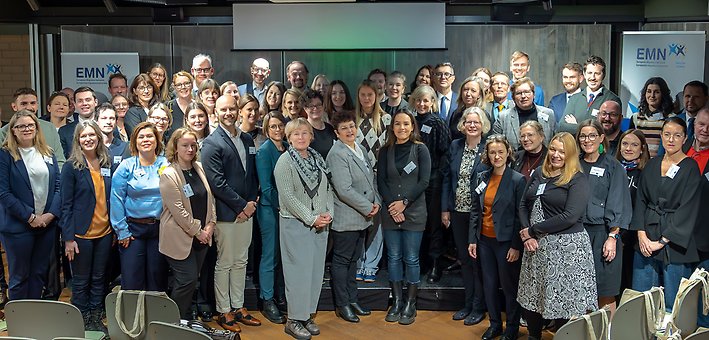
Insights from EMN Sweden National Conference 2025
The EMN Sweden National Conference "A Common European Approach to Labour Shortages and Talent Attraction" brought together policymakers, researchers, social partners and representatives from government agencies, private sector, foreign embassies and international organisations to exchange knowledge and explore policies, initiatives and innovative practices addressing labour shortages and strengthening the EU’s global competitiveness for talent. European mobility for third-country nationals is growing in importance by using key tools such as the EU Blue Card, Talent Partnerships and bilateral engagement with third countries. Intergovernmental initiatives like “Work in Sweden” are being scaled up across EMN countries.
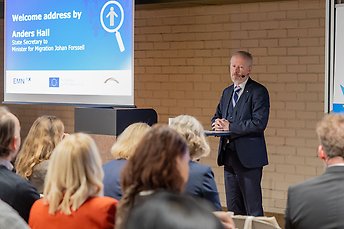
Welcome Address by Anders Hall, State Secretary to the Swedish Minister for Migration
The conference was held on 3 December 2025 in Stockholm. Labour shortages and international talent attraction are growing challenges across Europe. In Sweden, attracting and recruiting international talents is high on the agenda, with labour shortages posing a major obstacle to business growth and competitiveness. Two recent comparative EMN-OECD* reports outlined findings on innovative ways to attract foreign talent and to tackle labour shortages.
A welcome address was delivered by Mr Anders Hall, State Secretary to the Minister for Migration Johan Forsell. He made an overview of Sweden’s migration policy development and highlighted the shift from primarily asylum-related migration towards labour migration, with a growing focus on attracting highly qualified professionals lately. The overarching goal for Sweden is to become a top destination for talent and entrepreneurship.
The opening was followed by two sessions, focused on initiatives at the European level to attract talent and retain skills. The first panel featured speakers from the Organisation for Economic Co-operation and Development (OECD), the Migration Policy Institute (MPI) Europe, Uppsala University, the Swedish Public Employment Service. The second panel has hosted experts from EMN Member Countries Austria, Lithuania, Finland and Germany, sharing national examples on how to attract talent and facilitate labour migration. Among the presented insights were that the EU is projected to lose 5 million workers by 2030 and already faces a deficit of 2 million workers in the healthcare sector EU-OECD countries are hosting 22% of highly skilled migrants, while labour shortages cost over $1,3 trillion annually.
In the afternoon, participants have taken part in three break-out sessions where they had the opportunity to share national experiences and engage in a peer discussion on how successful approaches can be adapted to different contexts. Conference concluding remarks have been delivered by Hanna Geurtsen, Deputy Head of the Special Focus Area on the Work Permit Process, the Swedish Migration Agency and Mats Wessman, Project Manager for the government assignment “Work in Sweden”, the Swedish Agency for Economic and Regional Growth. These are two of the several authorities jointly tasked with the intergovernmental assignment "Work in Sweden". Anna Lindblad, Chief of Staff of the Office of the Director-General at the Swedish Migration Agency wrapped up the day with some insights.
Some Key Takeaways
- Migration continues to be part of the broader solution to address growing demographic challenges in an era of digital and green transition.
- Collaborative approach nationally is needed at all levels to attract and retain global talent.
- A need for greater harmonisation of labour migration policies within the EU and bilateral agreements with third countries to ensure a more competitive and efficient system for attracting talent.
- European mobility for third-country nationals is growing in importance with using key tools such as the EU Blue Card, Talent Partnerships and a unified EU Talent Pool to better linking supply with demand in shortage occupations.
- National policies should align with the needs of businesses and workers and efforts should be made to simplify the hiring process for third-country nationals.
- Local governments play a crucial role in attracting talent, but more support and coordination from national authorities are required.
- Regional and national cooperation is important in overcoming barriers to cross-border labour mobility within the EU. A fully integrated labour market within the Greater Copenhagen region would result in an estimated annual profit of € 910 million.
- Further efforts in communication, information sharing, and country attractiveness are essential for successful integration of international talent.
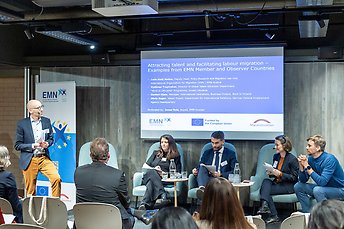
Experts from Sweden, Austria, Finland, Germany and Lithuania during Session 2
Attracting Talent and Facilitating Labour Migration: Examples from EMN Member Countries
- Almost all EMN countries reported on implemented significant changes to their labour migration systems; most of them have a primarily demand driven approach;
- Salary thresholds remain a key policy instrument in 14 EMN Member Countries; targeted measures for specific sectors are present in 13 EMN Member Countries.
- Austria has a national key tool for skilled immigration – the Red-White-Red Card (RWR Card). It has partnerships agreements with India, Ghana, the Philippines, Indonesia, Kenya and one with Brazil on the way.
- Finland’s programme “Work in Finland” highlights the country approach to talent attraction and labour migration collaboration. Among the partner countries are Brazil, India, Vietnam and the Philippines. Highly skilled specialists are targeted in areas such as quantum technology, microelectronics, AI, photonics, health technologies.
- Lithuania’s programme “Work in Lithuania” provides insights into the country’s approach to talent attraction with a clear transition from ICT sector to engineering due to a generation shift among skilled workers. In 2024, the piloted new markets were Albania, Turkey, United Kingdom, the Philippines, South Africa, Argentina, Brazil, El Salvador, Mexico.
- Germany has identified 13 focus countries for partnership agreements in Asia (India, Indonesia, the Philippines, Uzbekistan), Sub-Saharan Africa (Ghana), the MENA-region (Egypt, Jordan, Morocco, Tunisia) and Latin America (Brazil, Mexico, Colombia, Ecuador). Furthermore, the country has a strong focus on providing advisory services to companies to hire international talents.
- Intergovernmental initiatives like “Work in Sweden” are being scaled up across EMN countries.
- Labour migration remains a theme in 2026 EMN Publications.
State of Play in Sweden: Insights
- A need for a stronger collaboration among government authorities, private sector, universities, municipalities, and regions to create an appealing and comprehensive package for international talents.
- Skills shortages are a challenge for local authorities and regions and clarity in a complex regulatory framework is needed.
- Recruitment of third-country nationals requires coloration and persistence.
- It is important to find ways to scale up the intergovernmental assignment “Work in Sweden” in relation to the EU Blue Card and Talent Pools.
- More than half of the applications for the revised EU Blue Card are submitted by employees, already working in Sweden.
- According to 2024 TechSverige, Sweden needs approximately 18 000 new talents each year to meet the demand in technical industries.
- According to a recent survey, conducted by Statistics Sweden, one in five small and medium-sized enterprises (SMEs) have recruited qualified international staff in the past two years, whereas the proportion is higher among knowledge-intensive enterprises - one in four have hired international talents.
* EMN-OECD joint inform "New and innovative ways to attract foreign talents in the EU" and EMN-OECD joint study "Labour migration in times of labour shortages"
More information
- Access the Conference Agenda on our website.
- Access photos from the conference on our website.
- The Summary Report pdf, 441.6 kB. from the EMN Sweden National Conference 2025. (pdf)
- Read more and download the EMN-OECD joint inform"New and innovative ways to attract foreign talents in the EU Länk till annan webbplats, öppnas i nytt fönster." on the EU Commission’s website.
- Read more and download the EMN-OECD joint study "Labour migration in times of labour shortages Länk till annan webbplats, öppnas i nytt fönster." on the EU Commission’s website.
- Read more in Statistics Sweden’s recent report (in Swedish) "Small and Medium-Sized Enterprises: Experiences of International Recruitment". Länk till annan webbplats, öppnas i nytt fönster.
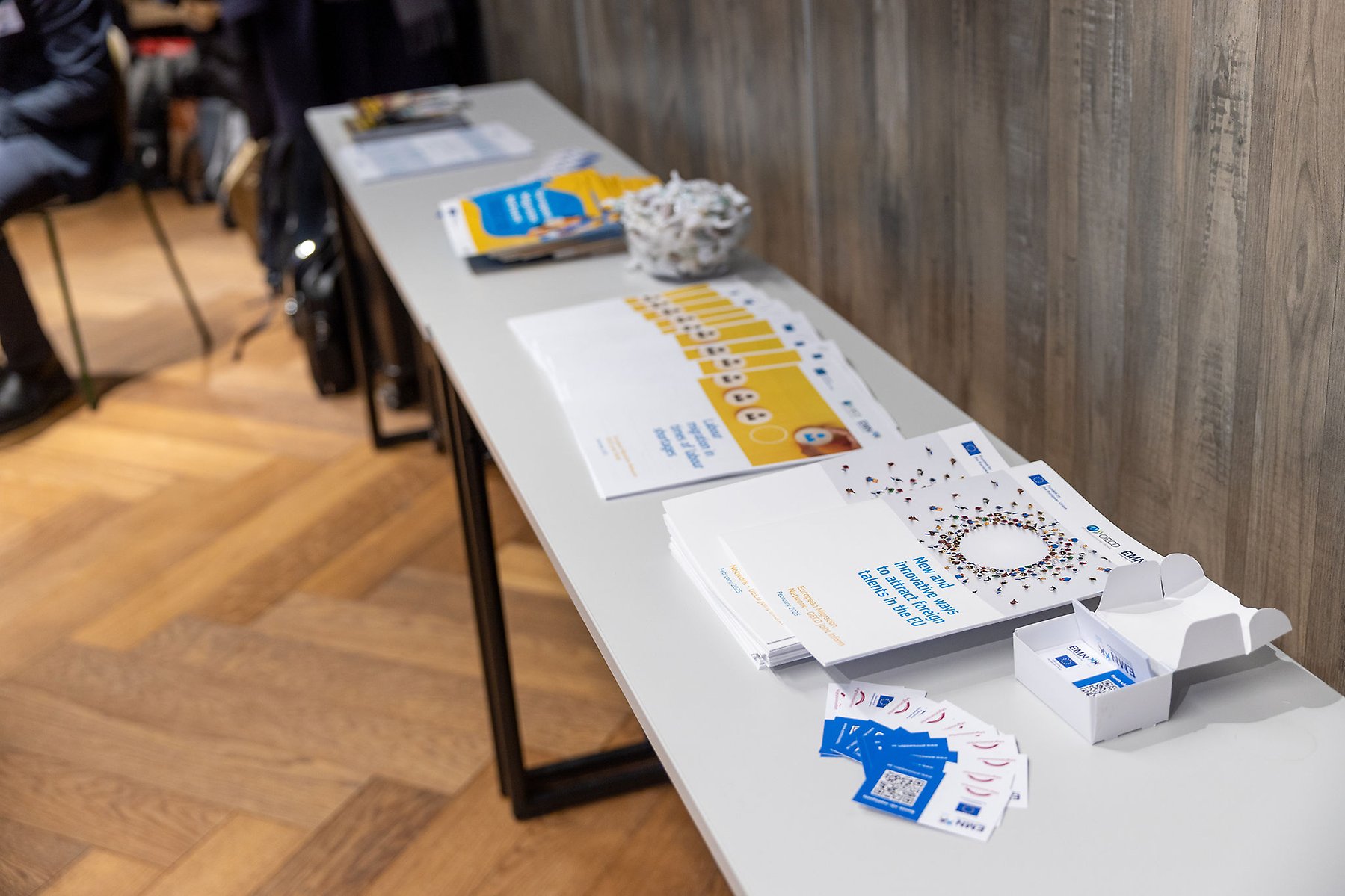
All photos are taken by Brandon Sandén.
Information på svenska
Den här delen på webbplatsen är avsedd för EMN Sveriges nationella konferens"A Common European Approach to Labour Shortages and Talent Attraction". Kort information på svenska finns på vår webbplats.
Konferensen genomfördes på engelska och all information på konferensens websida publiceras på engelska.